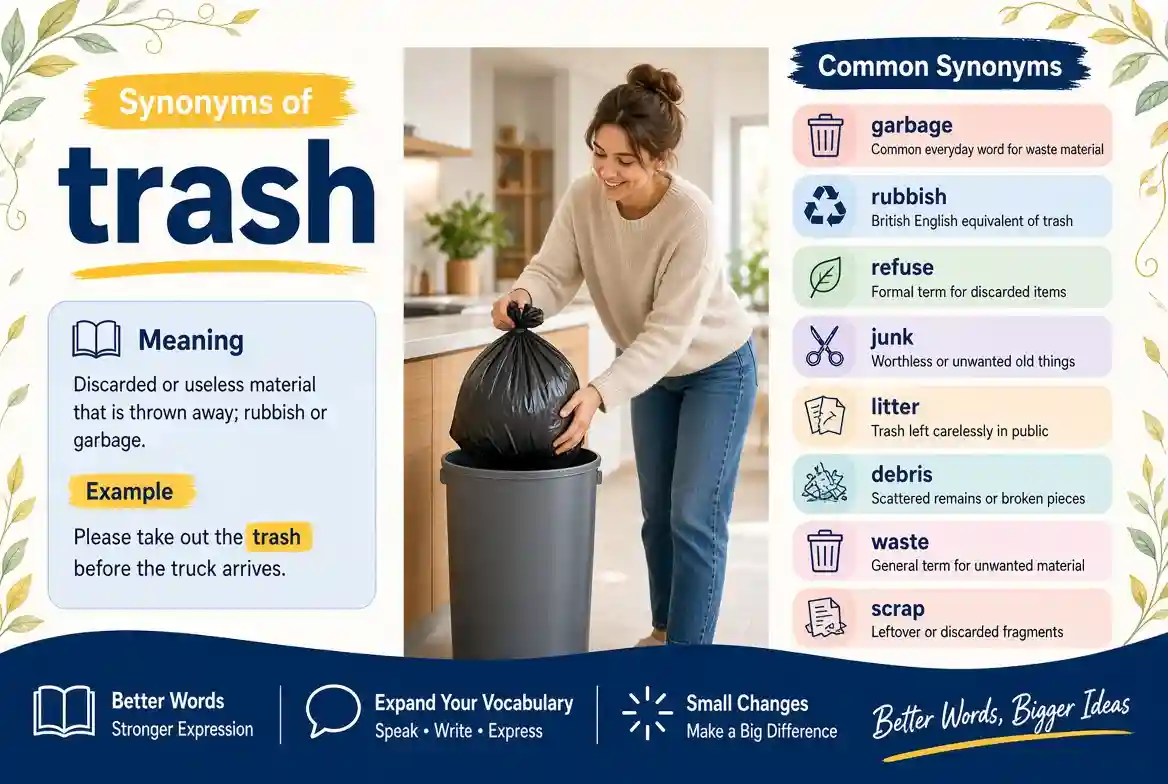
Quick Answer: What Are Synonyms for Trash?
The best synonyms for trash include garbage, rubbish, waste, junk, refuse, litter, debris, scraps, and discarded material. These words describe unwanted things, but their meanings differ. Garbage usually refers to household waste, litter describes waste left in public places, and debris means scattered pieces left after damage.
What word should you use when you do not want to repeat trash in every sentence?
English has many alternatives, but choosing the right one is important. For example, you can call unwanted household items junk, food waste garbage, and broken pieces of a damaged building debris. Each word gives the reader a slightly different picture.
Learning synonyms for trash can improve your vocabulary, essays, emails, and everyday conversations. It also helps you write more naturally without using difficult words unnecessarily.
In this guide, you will learn 30 useful alternatives, their meanings, original examples, pronunciation, formality, and common expressions. You will also discover which words work best in American and British English and which alternatives you should avoid in formal writing.
1. Pronunciation and Meaning of Trash
- Word: Trash
- IPA: /træʃ/
- Pronunciation: TRASH
- Syllables: One
- Part of speech: Noun and verb
- American English: Common everyday word.
- British English: Usually replaced by rubbish.
Simple definition: Trash means unwanted material, old things, or items that people no longer need and throw away.
It can also describe something considered worthless or poor in quality.
Examples:
- Please put the trash in the bin.
- I think that movie is complete trash.
The first sentence describes physical waste. The second expresses a negative opinion.
2. Part of Speech and Grammar
| Word form | Part of speech | Meaning | Example |
| Trash | Noun | Unwanted material | The trash smells bad. |
| Trash | Verb | Damage, discard, or criticize | They trashed the old room. |
| Trashed | Past tense | Damaged or discarded | Someone trashed the furniture. |
| Trashing | Present participle | Damaging or criticizing | He is trashing the proposal. |
| Trashy | Adjective | Cheap, vulgar, or poor in quality | It was a trashy television show. |
Is Trash Countable or Uncountable?
When trash means household waste, it is normally an uncountable noun.
Correct:
- There is too much trash outside.
- A bag of trash is near the door.
- Please remove the trash.
Incorrect:
– There are many trash cans outside.
Use bags of trash, pieces of trash, or types of waste when you need to count things.
Common Grammar Patterns
- Throw something in the trash.
- Take out the trash.
- Pick up trash.
- Dispose of waste.
- Collect household garbage.
- Talk trash about someone.
3. 30 Best Synonyms for Trash With Examples
The following list includes physical-waste alternatives, words for leftover material, and figurative expressions for worthless ideas. The categories identify their actual usage rather than suggesting that all 30 words are interchangeable.
| No. | Synonym | Meaning | Register |
| 1 | Garbage | Household waste | Neutral |
| 2 | Rubbish | Unwanted material | Neutral |
| 3 | Waste | Unwanted material or by-products | Formal |
| 4 | Junk | Useless or unwanted things | Informal |
| 5 | Refuse | Discarded material | Formal |
| 6 | Litter | Waste left carelessly | Neutral |
| 7 | Debris | Scattered broken material | Formal |
| 8 | Scrap | Leftover material | Neutral |
| 9 | Scraps | Small leftover pieces | Neutral |
| 10 | Clutter | Unwanted or untidy objects | Neutral |
| 11 | Rubble | Broken stones and bricks | Neutral |
| 12 | Residue | Material left behind | Formal |
| 13 | Detritus | Accumulated remains | Literary |
| 14 | Sweepings | Material collected by sweeping | Neutral |
| 15 | Filth | Very dirty material | Strong |
| 16 | Castoffs | Unwanted possessions | Neutral |
| 17 | Offcuts | Pieces left after cutting | Technical |
| 18 | Leftovers | Unused remaining food or items | Neutral |
| 19 | Leavings | Things left behind | Literary |
| 20 | Dross | Worthless material | Literary |
| 21 | Dregs | Unwanted remains at the bottom | Literary |
| 22 | Odds and ends | Miscellaneous small objects | Informal |
| 23 | Nonsense | Foolish or meaningless ideas | Neutral |
| 24 | Drivel | Foolish speech or writing | Informal |
| 25 | Hogwash | Completely foolish ideas | Informal |
| 26 | Balderdash | Ridiculous or false talk | Informal |
| 27 | Twaddle | Silly or pointless talk | Informal |
| 28 | Rot | Nonsense or untrue talk | Informal |
| 29 | Garbage (figurative) | Worthless content or ideas | Informal |
| 30 | Rubbish (figurative) | Foolish or poor-quality content | Informal |
Physical Waste and Unwanted Material
1. Garbage
Meaning: Unwanted household material, especially food and other kitchen waste.
Examples:
- The garbage truck arrived before sunrise.
- We separated food scraps from the household garbage.
Best used when: Discussing everyday household waste in American English.
- Tone: Neutral
- CEFR guidance: B1
- Frequency: Very common
- Collocations: Garbage truck, garbage bag, household garbage
- When not to use: Avoid it when describing only scattered building fragments.
2. Rubbish
Meaning: Things that people no longer need and throw away.
Examples:
- The family collected rubbish before moving to a new house.
- Please put the empty packages in the rubbish bin.
Best used when: Discussing general household waste, especially in British English.
- Tone: Neutral
- CEFR guidance: B1
- Frequency: Very common
- Collocations: Rubbish bin, rubbish collection, household rubbish
- When not to use: Avoid it in American writing if trash or garbage sounds more natural.
3. Waste
Meaning: Unwanted material produced by people, homes, or businesses.
Examples:
- The restaurant introduced new rules to reduce food waste.
- The factory must manage its industrial waste carefully.
Best used when: Writing about environmental issues, business, recycling, and manufacturing.
- Tone: Formal/neutral
- CEFR guidance: B1
- Frequency: Very common
- Collocations: Industrial waste, food waste, waste management
- When not to use: Avoid using it as a replacement for every casual use of trash.
4. Junk
Meaning: Old, unwanted, or useless objects.
Examples:
- We discovered boxes of junk in the basement.
- He sold his old junk at a neighborhood garage sale.
Best used when: Describing unwanted possessions, broken objects, and miscellaneous belongings.
- Tone: Informal
- CEFR guidance: B1
- Frequency: Very common
- Collocations: Junk mail, junk food, old junk
- When not to use: Do not use it as a technical term for hazardous industrial waste.
5. Refuse
Meaning: Discarded material that people no longer want.
Examples:
- The council arranged a weekly refuse collection.
- Workers separated recyclable materials from general refuse.
Best used when: Writing formal reports and discussing waste collection.
- Tone: Formal
- CEFR guidance: C1
- Frequency: Common in formal contexts
- Collocations: Domestic refuse, refuse collection, refuse disposal
- When not to use: Do not confuse the noun with the verb refuse, meaning to say no.
6. Litter
Meaning: Waste carelessly left in streets, parks, beaches, or other public places.
Examples:
- Volunteers collected litter along the walking trail.
- Plastic bottles and food wrappers covered the beach.
Best used when: Discussing public cleanliness and pollution.
- Tone: Neutral
- CEFR guidance: B1
- Frequency: Very common
- Collocations: Pick up litter, litter pollution, litter bin
- When not to use: Do not use it for properly stored household waste.
7. Debris
Meaning: Scattered pieces left after something breaks, falls, or gets damaged.
Examples:
- Strong winds scattered debris across the road.
- Rescue workers searched through the building debris.
Best used when: Describing destruction, construction sites, storms, or accidents.
- Tone: Formal
- CEFR guidance: B2
- Frequency: Common
- Collocations: Storm debris, building debris, flying debris
- When not to use: Avoid it for ordinary food or kitchen waste.
8. Scrap
Meaning: A leftover piece of material that remains after something is used or made.
Examples:
- The carpenter saved a scrap of wood for repairs.
- The workshop sold its scrap metal to a recycling company.
Best used when: Discussing leftover wood, paper, metal, or other materials.
- Tone: Neutral
- CEFR guidance: B1
- Frequency: Common
- Collocations: Scrap metal, scrap paper, scrap wood
- When not to use: Remember that scrap material may still have value.
9. Scraps
Meaning: Small remaining pieces of food or other materials.
Examples:
- The farmer fed the chickens vegetable scraps.
- She used fabric scraps to make a colorful cushion.
Best used when: Describing small leftover pieces that may be reused.
- Tone: Neutral
- CEFR guidance: B1
- Frequency: Common
- Collocations: Food scraps, fabric scraps, paper scraps
- When not to use: Do not use it for large quantities of mixed rubbish.
10. Clutter
Meaning: Too many untidy or unnecessary objects in one place.
Examples:
- Old magazines created clutter on the office desk.
- She removed unnecessary clutter from her bedroom.
Best used when: Discussing messy rooms, crowded spaces, and unnecessary belongings.
- Tone: Neutral
- CEFR guidance: B2
- Frequency: Very common
- Collocations: Household clutter, digital clutter, clear clutter
- When not to use: Do not assume everything described as clutter is useless or ready to be thrown away.
11. Rubble
Meaning: Broken stones, bricks, and other pieces left after a building is damaged or demolished.
Examples:
- Workers cleared the rubble from the damaged house.
- Heavy machinery moved the rubble into large trucks.
Best used when: Discussing demolition and damaged buildings.
- Tone: Neutral
- CEFR guidance: B2
- Frequency: Common
- Collocations: Building rubble, pile of rubble, rubble removal
- When not to use: Do not use it for paper, food, or plastic waste.
12. Residue
Meaning: A small amount of material remaining after something has been used or processed.
Examples:
- The cleaning solution left a sticky residue on the glass.
- Researchers examined the chemical residue in the container.
Best used when: Discussing cleaning, manufacturing, science, and chemical substances.
- Tone: Formal/scientific
- CEFR guidance: B2
- Frequency: Common
- Collocations: Chemical residue, sticky residue, food residue
- When not to use: Avoid it when you mean an entire pile of household rubbish.
13. Detritus
Meaning: Broken or decayed material that collects after something is used or destroyed.
Examples:
- Fallen leaves and natural detritus covered the forest floor.
- The cleanup team removed the detritus from the abandoned building.
Best used when: Writing about natural remains, environmental material, and accumulated debris.
- Tone: Literary/academic
- CEFR guidance: C2
- Frequency: Uncommon
- Collocations: Organic detritus, urban detritus, accumulated detritus
- When not to use: Do not use it in simple conversations when rubbish is clearer.
14. Sweepings
Meaning: Dust, dirt, and small pieces collected by sweeping.
Examples:
- The cleaner gathered the floor sweepings into a dustpan.
- Street sweepings were collected after the weekend festival.
Best used when: Describing material removed during cleaning.
- Tone: Neutral
- CEFR guidance: C1
- Frequency: Uncommon
- Collocations: Floor sweepings, street sweepings, dust sweepings
- When not to use: Avoid it for large discarded objects.
15. Filth
Meaning: Extremely dirty or unpleasant material.
Examples:
- The abandoned kitchen was covered in filth.
- Workers removed the filth that had collected behind the restaurant.
Best used when: Emphasizing very dirty or unpleasant conditions.
- Tone: Strong/negative
- CEFR guidance: B2
- Frequency: Common
- Collocations: Covered in filth, dirt and filth, filthy conditions
- When not to use: Do not use it as a neutral name for ordinary rubbish.
16. Castoffs
Meaning: Things that people no longer want and give away or throw away.
Examples:
- The charity collected castoff clothes for families.
- She transformed old furniture castoffs into useful decorations.
Best used when: Discussing unwanted clothes, furniture, and possessions.
- Tone: Neutral
- CEFR guidance: C1
- Frequency: Uncommon
- Collocations: Clothing castoffs, unwanted castoffs, household castoffs
- When not to use: Avoid it for food waste and hazardous substances.
17. Offcuts
Meaning: Pieces remaining after a larger piece of material has been cut.
Examples:
- The tailor saved fabric offcuts for smaller projects.
- The carpenter reused wooden offcuts to make shelves.
Best used when: Discussing tailoring, construction, woodworking, and manufacturing.
- Tone: Technical/neutral
- CEFR guidance: C1
- Frequency: Common in specialist contexts
- Collocations: Fabric offcuts, timber offcuts, material offcuts
- When not to use: Do not use it for general household rubbish.
18. Leftovers
Meaning: Food or other things that remain unused after an activity.
Examples:
- We stored the dinner leftovers in separate containers.
- The school donated leftover supplies to a community center.
Best used when: Talking about extra food or unused supplies.
- Tone: Neutral
- CEFR guidance: A2
- Frequency: Very common
- Collocations: Food leftovers, dinner leftovers, leftover food
- When not to use: Do not confuse usable leftovers with spoiled food.
19. Leavings
Meaning: Things left behind after someone has used or taken what they wanted.
Examples:
- Birds searched the picnic area for food leaves.
- The workers removed the leaves from the production area.
Best used when: Describing remaining material, especially in literary or descriptive writing.
- Tone: Literary
- CEFR guidance: C1
- Frequency: Uncommon
- Collocations: Food leavings, table leavings, unwanted leavings
- When not to use: Use leftovers for ordinary conversations about meals.
20. Dross
Meaning: Worthless material separated from something valuable.
Examples:
- The metalworkers removed dross during the production process.
- The editor removed the dross and kept the strongest parts of the manuscript.
Best used when: Discussing metal production or figuratively describing inferior material.
- Tone: Literary/technical
- CEFR guidance: C2
- Frequency: Rare
- Collocations: Industrial dross, remove dross, literary dross
- When not to use: Do not use it as a common alternative for household garbage.
21. Dregs
Meaning: Small unwanted remains that settle at the bottom of a liquid.
Examples:
- He poured the last dregs of coffee into the sink.
- The glass contained only a few dregs of muddy water.
Best used when: Talking about liquid remains or the least desirable part of something.
- Tone: Neutral/literary
- CEFR guidance: C2
- Frequency: Uncommon
- Collocations: Coffee dregs, wine dregs, dregs of society
- When not to use: Avoid it for general household rubbish.
22. Odds and Ends
Meaning: A collection of small, different things that do not belong to one particular group.
Examples:
- The drawer contained batteries, buttons, and other odds and ends.
- We packed the remaining odds and ends before moving.
Best used when: Describing miscellaneous belongings in casual conversation.
- Tone: Informal
- CEFR guidance: B2
- Frequency: Common
- Collocations: Household odds and ends, little odds and ends, odds and ends drawer
- When not to use: Avoid it in formal environmental reports.
Figurative Alternatives: When Trash Means Nonsense
These words belong to a different meaning group. They describe foolish statements, poor-quality writing, or worthless information, not physical garbage.
23. Nonsense
Meaning: Ideas or statements that are foolish, meaningless, or untrue.
Examples:
- The article contained nonsense instead of reliable information.
- Please stop spreading nonsense about the new school policy.
Best used when: Rejecting false claims or foolish statements.
- Tone: Neutral
- CEFR guidance: B1
- Frequency: Very common
- Collocations: Complete nonsense, talk nonsense, absolute nonsense
- When not to use: Do not use it for physical waste.
24. Drivel
Meaning: Foolish or meaningless speech or writing.
Examples:
- The reviewer called the poorly researched article drivel.
- I stopped reading the post because it was full of drivel.
Best used when: Criticizing pointless writing or conversation.
- Tone: Informal/dismissive
- CEFR guidance: C1
- Frequency: Uncommon
- Collocations: Utter drivel, written drivel, talking drivel
- When not to use: Avoid it in polite professional feedback.
25. Hogwash
Meaning: Ideas or statements that are completely foolish or untrue.
Examples:
- The scientist explained why the online rumor was hogwash.
- She dismissed the advertisement’s unrealistic promises as complete hogwash.
Best used when: Strongly rejecting an unbelievable claim.
- Tone: Informal
- CEFR guidance: C1
- Frequency: Uncommon
- Collocations: Complete hogwash, absolute hogwash, dismiss as hogwash
- When not to use: Avoid it in formal academic writing.
26. Balderdash
Meaning: Foolish or unbelievable talk.
Examples:
- The professor dismissed the unsupported claim as balderdash.
- That explanation sounds like complete balderdash.
Best used when: Expressing strong disagreement in a colorful way.
- Tone: Informal/old-fashioned
- CEFR guidance: C2
- Frequency: Rare
- Collocations: Complete balderdash, utter balderdash, absolute balderdash
- When not to use: Use nonsense instead in ordinary professional communication.
27. Twaddle
Meaning: Silly, unimportant, or pointless talk and writing.
Examples:
- The discussion quickly turned into meaningless twaddle.
- He ignored the twaddle circulating in the online comments.
Best used when: Criticizing unimportant conversation or writing.
- Tone: Informal/old-fashioned
- CEFR guidance: C2
- Frequency: Rare
- Collocations: Utter twaddle, complete twaddle, talking twaddle
- When not to use: Do not use it for physical rubbish.
28. Rot
Meaning: Foolish or untrue statements.
Examples:
- The teacher told the students not to believe such rot.
- I have never heard such complete rot about science.
Best used when: Dismissing an argument or statement as nonsense.
- Tone: Informal, especially British usage
- CEFR guidance: C1
- Frequency: Uncommon
- Collocations: Complete rot, talk rot, utter rot
- When not to use: Avoid it when discussing physical waste.
29. Garbage (Figurative)
Meaning: Something considered worthless, unreliable, or very poor in quality.
Examples:
- The reviewer described the poorly made film as garbage.
- Do not believe the garbage spreading across social media.
Best used when: Expressing a strong negative opinion about information, entertainment, or ideas.
- Tone: Informal
- CEFR guidance: B2
- Frequency: Common
- Collocations: Complete garbage, garbage information, garbage content
- When not to use: Avoid this expression in polite formal criticism.
30. Rubbish (Figurative)
Meaning: Foolish ideas, false statements, or something of very poor quality.
Examples:
- The journalist rejected the rumor as rubbish.
- That television program was entertaining, but the story was rubbish.
Best used when: Expressing a negative opinion, especially in British English.
- Tone: Informal
- CEFR guidance: B2
- Frequency: Common
- Collocations: Complete rubbish, talk rubbish, absolute rubbish
- When not to use: Avoid it in formal criticism when a more precise explanation is needed.
4. Strongest Synonyms, Strong Synonyms, and Related Words
Not all alternatives have the same level of similarity.
Strongest Synonyms
These are the most useful direct alternatives when trash means unwanted material:
- Garbage
- Rubbish
- Waste
- Junk
- Refuse
- Litter
Strong Synonyms
These describe particular forms of discarded or unwanted material:
- Debris
- Scrap
- Scraps
- Rubble
- Residue
- Castoffs
- Clutter
- Sweepings
Related and Figurative Words
These words have narrower meanings or refer to foolish communication:
- Detritus
- Dross
- Dregs
- Leavings
- Offcuts
- Nonsense
- Drivel
- Hogwash
- Balderdash
- Twaddle
- Rot
Remember: A word can be related to trash without being a direct synonym. For example, rubble describes broken building material, while nonsense describes foolish ideas.
5. Choose the Right Synonym: Side by Side Comparison
This is one of the most important parts of learning new vocabulary. Compare the following words to understand their differences.
| Word | Main difference | Example |
| Trash | General unwanted material | Take out the trash. |
| Garbage | Commonly household and food waste | The garbage smells bad. |
| Rubbish | General discarded material, especially British usage | Put it in the rubbish bin. |
| Waste | Broad term for unwanted material | Reduce industrial waste. |
| Junk | Unwanted or useless possessions | Clear out the junk. |
| Litter | Waste left carelessly in public | Pick up the litter. |
| Debris | Scattered broken material | Remove the storm debris. |
| Rubble | Broken bricks and stones | Clear the building rubble. |
| Scrap | Leftover pieces of material | Save the scrap metal. |
| Residue | Material remaining after a process | Remove the sticky residue. |
Which Synonym Should You Choose?
Use these simple rules:
- Everyday American English: Trash or garbage.
- Everyday British English: Rubbish.
- Academic writing: Waste or discarded material.
- Environmental discussions: Waste or litter.
- Old unwanted possessions: Junk.
- Construction damage: Debris or rubble.
- Foolish statements: Nonsense or rubbish.
- Poor-quality writing: Drivel or garbage, depending on tone.
6. American vs. British English: Trash or Rubbish?
American and British speakers often choose different words for the same thing.
| Expression | American English | British English |
| Household waste | Trash / garbage | Rubbish |
| Waste container | Trash can | Rubbish bin / dustbin |
| Waste bag | Trash bag | Bin bag |
| Waste collection | Trash collection | Rubbish collection |
| Waste worker | Garbage collector | Refuse collector |
| Large waste container | Dumpster | Skip |
Pronunciation:
| Word | IPA |
| Trash | /træʃ/ |
| Garbage | /ˈɡɑːrbɪdʒ/ |
| Rubbish | /ˈrʌbɪʃ/ |
| Refuse (noun) | /ˈref.juːs/ |
| Refuse (verb) | /rɪˈfjuːz/ |
The noun refuse and the verb refuse have different pronunciations.
The spelling of trash, garbage, and rubbish remains the same in both varieties of English.
An additional distinction is that some American speakers use garbage mainly for food waste and trash for other discarded materials. However, this is a tendency, not a universal rule.
English meaning – Cambridge Dictionary+2
7. Word Origin and Etymology of Trash
The history of trash is more interesting than its modern meaning suggests.
Historical records trace the noun to Middle English around the 15th century, with early meanings connected to fallen leaves, twigs, brushwood, and things of little value.
Its ultimate origin is uncertain. A Scandinavian connection has been suggested because some related Scandinavian words referred to twigs, rubbish, or broken material. However, this explanation is not universally established.
OUPblog+1
Historical Development
| Period | Recorded meaning |
| Around 1400 | Fallen leaves, brushwood, and twigs |
| 16th century | Worthless writing and ideas |
| 17th century | Derogatory descriptions of people |
| Early 20th century | Household garbage and domestic refuse |
| Modern English | Physical waste, poor-quality content, and figurative criticism |
The word trash also developed several verb meanings, including discarding something, damaging property, and criticizing something harshly.
Etymology, Origin & Meaning+1
Interesting fact: The word litter also has a long semantic history. It originally referred to a portable couch and later to straw used for bedding before developing its modern waste-related meaning.
OUPblog
8. CEFR Vocabulary Guide
CEFR stands for Common European Framework of Reference for Languages. It describes language ability from beginner to advanced.
The following levels are approximate learning recommendations, not official dictionary classifications.
| Level | Words to learn |
| A1–A2 | Trash, leftovers |
| B1 | Garbage, rubbish, waste, junk, litter, scraps |
| B2 | Clutter, debris, rubble, residue, nonsense |
| C1 | Refuse, sweepings, castoffs, offcuts, drivel |
| C2 | Detritus, dross, dregs, twaddle, balderdash |
My recommendation: If you are learning English, start with the first six common words. Learn the more advanced expressions only when you encounter them in reading or writing.
9. Commonly Confused Words
These five comparisons will help you avoid incorrect word choices.
| Word pair | Difference | Example |
| Trash vs. litter | Litter is waste left carelessly in public places. | Volunteers collected litter. |
| Garbage vs. waste | Waste has a broader meaning. | The factory produces industrial waste. |
| Junk vs. clutter | Junk is unwanted material; clutter is an untidy collection. | Old boxes created clutter. |
| Debris vs. rubble | Rubble mainly means broken building material. | Bricks formed a pile of rubble. |
| Scraps vs. leftovers | Scraps are small pieces; leftovers are unused remaining items. | We stored the food leftovers. |
10. Common Mistakes English Learners Should Avoid
Mistake 1: Using the wrong plural form
Incorrect:
There are many garbages outside.
Correct:
There is a lot of garbage outside.
Why? Garbage is normally uncountable when referring to discarded material.
Mistake 2: Confusing litter with household trash
Incorrect:
I put the litter in my kitchen bin.
Better:
I put the household trash in my kitchen bin.
Why? Litter usually refers to waste left carelessly in public or open spaces.
Mistake 3: Using debris for ordinary waste
Incorrect:
Please remove the kitchen debris.
Better:
Please remove the kitchen garbage.
Why? Debris normally refers to scattered broken or damaged material.
Mistake 4: Using informal words in professional writing
Less suitable:
Our company produces too much junk.
Better:
Our company generates excessive industrial waste.
Why? Industrial waste is more precise and professional.
Mistake 5: Treating nonsense as physical waste
Incorrect:
The workers collected nonsense from the street.
Correct:
The workers collected litter from the street.
Why? Nonsense describes foolish ideas, not physical objects.
11. Writing Tips: Use Synonyms Naturally
The best synonym depends on the type of writing and the audience.
Essays: Use waste, refuse, and discarded material when discussing pollution and recycling.
Example: “Reducing household waste protects natural resources.”
Emails: Use clear and polite expressions.
Example: “Please remove the unwanted materials from the storage room.”
Blog posts: Use familiar words that readers understand quickly.
Example: “Five easy ways to reduce kitchen garbage.”
Stories: Use debris, rubble, and scraps to create detailed descriptions.
Example: “Broken branches and debris covered the narrow road.”
Social media: Use informal words such as junk and trash.
Example: “Finally cleaned my room and got rid of all that junk!”
Professional communication: Choose precise terms such as industrial waste and recyclable materials.
Example: “Our organization has introduced a new industrial waste management policy.”
Writing Tip
Do not replace trash with a difficult word just to make your writing sound intelligent. Simple and accurate vocabulary is more effective than unnecessary complexity.
12. Related Vocabulary: Antonyms and Expressions
Antonyms of Trash
The opposite of trash depends on its meaning.
| Antonym | Meaning | Example |
| Treasure | Something valuable | The old painting was a treasure. |
| Valuables | Important or expensive belongings | Keep your valuables safe. |
| Asset | Something useful or valuable | Experience is a valuable asset. |
| Resource | Something useful that can be used | Water is an important resource. |
| Possession | Something owned by someone | He packed his personal possessions. |
| Prize | Something awarded or valued | The trophy was a special prize. |
Common Expressions With Trash
| Expression | Meaning | Example |
| Take out the trash | Remove household waste | I take out the trash every evening. |
| Talk trash | Insult or boast about someone | The players talked trash before the game. |
| Trash talk | Insulting or boastful speech | Ignore the online trash talk. |
| Trash something | Damage or throw something away | They trashed the old furniture. |
| One man’s trash is another man’s treasure | Something useless to one person may be valuable to another | She bought an old chair at a bargain price. |
| Trashed reputation | A badly damaged public image | False rumors can damage someone’s reputation. |
Word Family
| Word | Part of speech | Meaning |
| Trash | Noun | Unwanted material |
| Trash | Verb | Damage, discard, or criticize |
| Trashed | Verb/adjective | Damaged or discarded |
| Trashing | Verb form | Damaging or criticizing |
| Trashy | Adjective | Cheap, vulgar, or poor in quality |
13. Natural Collocations: Words That Go With Trash
Collocations are words that naturally appear together. Learning them makes your English sound more fluent.
| Word | Common combinations |
| Trash | Take out the trash, trash bag, trash can |
| Garbage | Garbage truck, garbage collection, household garbage |
| Rubbish | Rubbish bin, rubbish collection, household rubbish |
| Waste | Reduce waste, waste management, industrial waste |
| Junk | Junk mail, junk food, old junk |
| Litter | Pick up litter, litter pollution, litter bin |
| Debris | Storm debris, building debris, remove debris |
| Refuse | Refuse collection, domestic refuse, refuse disposal |
| Scrap | Scrap metal, scrap paper, scrap wood |
| Residue | Chemical residue, sticky residue, food residue |
Six Natural Example Sentences
These are original illustrative examples showing how the words work in natural English.
- The city introduced a new household waste collection program.
- Volunteers removed plastic litter from the riverbank.
- The laboratory discovered traces of chemical residue.
- The workshop recycled metal scraps into useful products.
- Heavy rainfall scattered construction debris across the road.
- The office reduced paper waste by using digital documents.
14. Frequently Asked Questions
1. What are the 10 best synonyms for trash?
The 10 useful synonyms for trash are garbage, rubbish, waste, junk, refuse, litter, debris, scrap, scraps, and discarded material. Each word has a different use. Garbage and rubbish describe everyday waste, while litter refers to waste left in public places and debris describes scattered broken material.
2. What is a more professional word for trash?
Waste is one of the best professional alternatives to trash. Other suitable choices include refuse, discarded material, and waste matter. These words work well in business reports, environmental documents, and formal emails. For example, use industrial waste instead of industrial trash in a technical report.
3. What is another word for trash in American English?
Garbage is one of the most common alternatives to trash in American English. Both words describe unwanted material that people throw away. Garbage often refers to food and household waste, while trash can also describe paper, packaging, and broken objects.
4. What is the British English word for trash?
Rubbish is the usual British English alternative to trash. British speakers commonly use expressions such as rubbish bin, rubbish bag, and rubbish collection. Americans generally prefer trash or garbage. Using the correct regional expression helps your everyday English sound more natural.
5. What is another word for trash when talking about nonsense?
Nonsense, drivel, hogwash, balderdash, and twaddle can describe foolish or meaningless information. Nonsense is the safest everyday choice. Drivel sounds more insulting, while hogwash and balderdash are informal expressions that can sound humorous or old-fashioned.
6. Are trash and garbage the same thing?
Trash and garbage have very similar meanings in American English. Some speakers use garbage mainly for food waste and trash for dry materials, but this distinction is not universal. Both words can describe unwanted household material, depending on the speaker and situation.
7. Is trash a noun or a verb?
Trash can be both a noun and a verb. As a noun, it means unwanted material or something considered worthless. As a verb, it can mean to throw something away, damage a place, or criticize something harshly. For example, “They trashed the old furniture.”
8. What is the opposite of trash?
The opposite of trash depends on the intended meaning. When trash means unwanted material, possible opposites include treasure, valuables, possessions, and useful resources. When it describes foolish information, its opposites include truth, sensible ideas, and useful information.
15. Vocabulary Quiz: Test Your Knowledge
Try these five questions to check what you have learned.
English vocabulary practice
0/5 answered
1. Which word is commonly used for everyday waste in British English?
A. Garbage
B. Rubbish
C. Debris
D. Scraps
2. Which word describes waste carelessly left in public places?
A. Residue
B. Dross
C. Litter
D. Refuse
3. What is the best word for broken bricks and stones?
A. Rubble
B. Leftovers
C. Clutter
D. Junk mail
4. Which word means foolish or meaningless speech?
A. Scrap
B. Drivel
C. Offcuts
D. Detritus
5. Which word describes material left after a process?
A. Litter
B. Balderdash
C. Residue
D. Castoffs
Check answers
16. Conclusion
Learning synonyms for trash helps you express ideas more clearly and naturally. Words such as garbage, rubbish, waste, junk, and litter give you more choices in everyday communication. However, each word has its own meaning and context.
Practice these alternatives in your essays, emails, schoolwork, and conversations. Focus on using the right word rather than memorizing every difficult expression. With regular practice, you can build a stronger vocabulary and become a more confident English speaker.
18. References and Verification Sources
These established dictionary and language references support the definitions, pronunciation, word history, and usage explanations in this article.
- Cambridge Dictionary: Trash Definition
- Cambridge Thesaurus: Trash Synonyms
- Thesaurus.com: Trash Synonyms and Antonyms
- Collins English Dictionary: Trash
- Oxford University Press: Historical Origin of Trash

Synonorm is a trusted English vocabulary resource created to help readers find the right words and understand the differences between similar terms. We provide clear explanations of synonyms, meanings, examples, usage, and alternatives. Our content makes vocabulary easier to learn and apply in everyday, academic, and professional English. Synonorm is designed for students, writers, ESL learners, professionals, and anyone who wants to improve their English vocabulary and communicate more clearly.